What are cannabinoids? An overview of CBD, CBDa, CBG


Inhaltsverzeichnis
Where do cannabinoids take effect?
What are endocannabinoids?
What are phytocannabinoids?
What is CBD (Cannabidiol)?
What is CBDA (cannabidiolic acid)?
What is THC (Tetrahydrocannabinol)?
Which phytocannabinoids are present in our products?
Where do cannabinoids act?
First, we need to provide some background. Most higher developed living beings have an endocannabinoid system. This is a complex system of substances, receptors, transporters, and enzymes produced by the body that together regulate a variety of functions in the body.
These include, for example:
- Temperature regulation
- Synaptic plasticity – learning and memory
- Appetite
- Blood pressure regulation
- Immune response
- Gastrointestinal motility
- Fat production
- Bone formation
- Fertility
- Pain perception
(Nicolussi and Gertsch 2015)
Substances produced by the body require enzymes for metabolism to be broken down and built up, as well as transporters to reach their site of action. However, the most important are the receptors, because substances bind there to initiate their mechanism of action.
What are endocannabinoids?
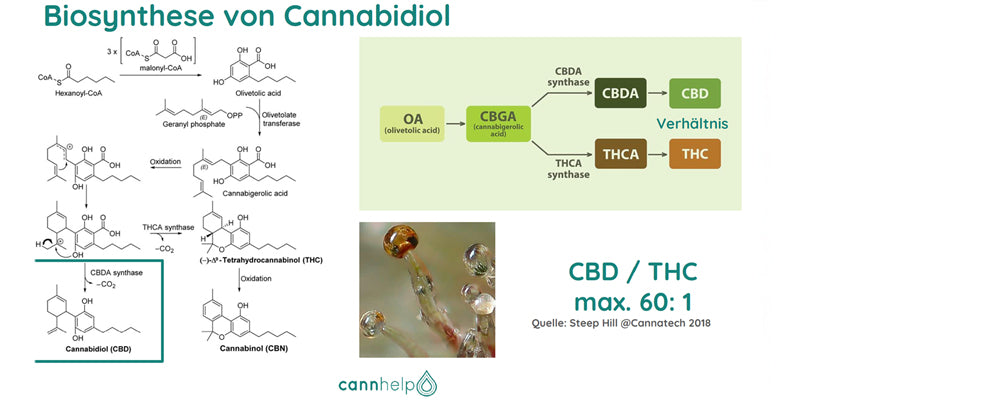
Here we come to cannabinoids. Literature states that substances that can act on receptors, transporters, or enzymes of the endocannabinoid system (ECS) are called cannabinoids. These can be further divided into endocannabinoids (produced by the body itself – e.g., anandamides and 2-AG), phytocannabinoids (produced in plants – e.g., CBD, THC & CBG), and synthetic cannabinoids (humans use chemical or molecular biological methods to synthesize cannabinoids – e.g., rimonabant, JWH-018, and AM-1220).
What are phytocannabinoids?
We find phytocannabinoids particularly exciting because they are found in some plants. Those who believe phytocannabinoids are only found in hemp plants are mistaken. Phytocannabinoids have already been detected in hops, cocoa, echinacea, and kava, and we are sure there are many other exciting plants. The more science studies the endocannabinoid system, the greater the diversity of involved receptors becomes. Whereas a few years ago the CB1 and CB2 receptors were the focus, now GPR55, GPR18, and GPR119 are of research interest.
What is CBD (cannabidiol)?
CBD is the cannabinoid most abundantly found in industrial hemp. It has always been present in hemp products and is considered very safe by the WHO (World Health Organization) as it shows no psychotropic effects. The physiological effects of CBD can be attributed to its interaction with a surprisingly high number of receptors, enzymes, and transporters in the body. These are not exclusively part of the endocannabinoid system, although the inhibitory effect on the GPR55 receptor and modulation of FAAH (fatty acid amide hydrolase) are exceptions. CBD can enhance the effects of various neurotransmitters and can modulate serotonin, dopamine, GABAA, glycine, and acetylcholine receptors. Furthermore, it has direct effects on adenosine receptors and thus on the immune system. Cannabidiol can positively stimulate bone formation and, like THC, shows antispasmodic, anti-inflammatory, and pain-relieving effects. The latter is linked to interactions with the TRPV1 receptor. The strongest known effect so far is its anxiolytic (anxiety-reducing) effect. Medically, CBD is currently used for childhood epilepsy – Dravet syndrome and Lennox-Gastaut syndrome (trade name: Epidiolex/Epidyolex) as well as for multiple sclerosis (trade name: Sativex/Nabiximols). As aroma products, dietary supplements containing hemp extracts, and CBD flowers, cannabidiol is accessible to the general public and is gaining popularity due to its natural origin.
What is CBDA (cannabidiolic acid)?
Cannabidiolic acid is the natural precursor of CBD and contains a carboxylic acid group. This makes it unstable but significantly more effective. Its effects are already being researched but are not yet as clearly described as those of cannabidiol.
What is THC (tetrahydrocannabinol)?
THC exists in a variety of configurations, the most common and well-known being delta-9-tetrahydrocannabinol. It is used as a medicinal drug under the names dronabinol/Marinol/Syndros and is derived from the hemp plant. Dronabinol is usually administered in oily solution or as capsules, with doses up to 20 mg/day. The synthetic derivative is called nabilone/Cesamet/Canemes and is effective in capsule form at much lower doses. Its applications are diverse, with anorexia, cachexia, and adjunct therapy to chemotherapy in cancer patients being primary uses. Due to its pain-relieving, anti-inflammatory, and antispasmodic effects, it is also used for various diseases such as multiple sclerosis (MS). THC has psychotropic properties and is regulated under narcotics law. Despite its widespread use among the population, no deaths from overdoses are known to date. THC is also a natural plant compound in hemp and thus present in hemp extracts. Below a legal threshold, it is considered safe and legal.
Of course, there are many other cannabinoids that are continuously being researched and are also present in trace amounts in natural hemp extracts. The most well-known among them are:
CBG (cannabigerol)
CBC (cannabichromene)
CBN (cannabinol)
CBDV (cannabidivarin)
THCV (tetrahydrocannabivarin)
CBDE (cannabielsoin)
CBM (cannabimovone)
Which phytocannabinoids are present in our products?
Besides the phytocannabinoids from hemp naturally contained in our CANNEXOL products, we are also working on other innovative products. Unfortunately, our hemp chocolate from QAQAO with CBD has not been in the assortment since 2019 due to the Novel Food regulation. However, we continue to work on new possibilities for product innovations with promising plant substances and various cannabinoids.
Quellenverzeichnis anzeigen