The Endocannabinoid System (ECS)


Inhaltsverzeichnis
What is the endocannabinoid system and how does it work?
What does the ECS do?
The complex function of the ECS
The Hidden System: Why the Endocannabinoid System Significantly Influences Our Health
Summary
What is the endocannabinoid system and how does it work?
In fact, the number of potential components of this system, whose origin was identified from studies on the mechanism of action of the psychotropic ingredient of some cannabis strains, Δ9-tetrahydrocannabinol (THC), has rapidly increased. It can therefore be confidently stated that science is continuously recognizing both the components and the physiological significance and expanding the understanding of it. What is certain is that the ECS plays an important role in many essential bodily functions.
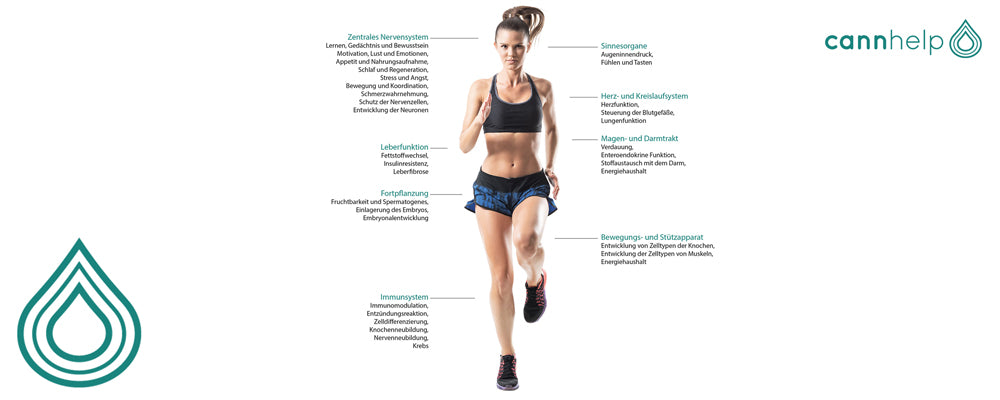
The definition of the term endocannabinoid (eCB) will surely change in the near future, as research on it is still relatively young. Around the turn of the century, the ECS was defined as the ensemble of the two G-protein-coupled receptors (GPCRs) CB1 (cannabinoid receptor type 1) and CB2. The CB1 receptor is the most abundantly expressed receptor in the central nervous system, which further increases its significance. Their two best-studied endogenous ligands – the substances that can bind to them – also called eCBs, are N-arachidonoylethanolamine (anandamide) and 2-arachidonoylglycerol (2-AG). The enzymes once thought to be solely responsible for eCB biosynthesis are N-acyl-phosphatidylethanolamine-selective phospholipase D (NAPE-PLD) and diacylglycerol lipases (DAGL) α and β, as well as those responsible for degradation, the hydrolytic inactivation, fatty acid amide hydrolase (FAAH) and monoacylglycerol lipase (MAGL).
However, this definition raises some semantic issues, as of the > 80 cannabinoids naturally found in cannabis, only THC (as an agonist) and the less common propyl analog, Δ9-tetrahydrocannabivarin (THCV) (as an antagonist), were able to bind with high affinity to CB1R and CB2R. Therefore, these two receptors should not be defined as "cannabinoid" receptors but rather as THC/THCV receptors. The definition of "cannabinoid receptor" should also include those proteins to which cannabinoids frequently bind, such as the thermosensitive transient receptor potential (TRP) cation channels. As a result, "endocannabinoids" should not only refer to the endogenous ligands of CB1R and CB2R but rather to all the ligands of these "cannabinoid receptors."
This results in AEA and 2-AG (which occurs about 1000 times more frequently in the brain than AEA) not being the only eCBs, which in turn implies that other enzymes responsible for the biosynthesis and inactivation of other mediators, which are ultimately included in the list of eCBs, are also assigned to the ECS. This conclusion clearly shows how difficult it can be to delineate a system within an organism, especially when it was discovered very late; yet its relevance is of utmost importance, as we can see from the physiological influences.
What does the ECS do?
According to all current knowledge, the ECS serves to maintain homeostasis. This is meant to keep the body and its functions in balance. A regulated state (whether body temperature, constant supply of oxygen and nutrients, immune defense, tissue development, reproduction, etc.) is a prerequisite for the development, survival, and regeneration of the cells that make up our organism and its function. Each target parameter is involved in complex regulatory circuits that collectively regulate our bodily functions. The ECS serves to maintain these regulatory circuits by dampening excessive reactions and/or modulating them when regulation is insufficient.
Retrograde control in neuronal communication is probably the best-researched control function of the eCB so far. When there is excessive innervation of receptors in the postsynaptic cell, the release of transmitter substances into the synaptic cleft is inhibited by retrograde signal transduction (postsynapse to presynapse). Simply put, the ECS dampens excessive neuronal communication with this mechanism. This naturally has physiological significance, especially at the level of memory performance, pain perception, and emotions.
The physiological relevance is greater than previously assumed. To name a few areas of influence:
|
Body area / system |
Function of the ECS |
|
Central nervous system (CNS) |
Pain modulation, mood, memory, neuroprotection |
|
Peripheral nervous system |
Pain transmission, sensory perception |
|
Immune system |
Inflammation regulation, immune response |
|
Digestive system |
Appetite, nausea, gut motility, mucosal protection |
|
Skin |
Cell regeneration, sebum production, inflammation control |
|
Reproductive system |
Hormone regulation, fertility, menstrual cycle |
|
Cardiovascular system |
Blood pressure regulation, vascular tone, stress response |
|
Skeletal system |
Bone remodeling, osteoclast/osteoblast activity |
|
Endocrine system |
Hormone release (e.g., cortisol, insulin, sex hormones) |
|
Sleep-wake rhythm |
Sleep onset regulation, sleep quality |
|
Metabolism |
Energy balance, glucose and fat metabolism |
The complex function of the ECS
Just as it regulates neuronal communication, the ECS regulates immune functions, especially in areas where the immune system (as previously defined) is less pronounced, such as the brain. The ECS influences the energy balance of neurons and can thus exert neuroprotective effects. The ECS has a direct impact on inflammatory reactions, part of our immune response to fight infections and as part of healing after injuries. AEA reportedly also inhibits functional activities of the immune system, particularly the production of pro-inflammatory cytokines (IL-2, TNF-α, and IF-γ).
The ECS controls the development of our body structure and regulates, via complex molecular gradients, for example, the networking of neurons in the embryo or the differentiation of cell types (e.g., osteoblasts/osteoclasts or myotubes/myofibrils). The ECS influences the endometrium, which is crucial for reproduction, as well as the regulation of spermatogenesis.
The ECS regulates appetite and the resulting intake of food and nutrients. The ECS of the gastrointestinal (GI) tract and the liver. AEA, 2-AG, and OEA (N-oleoylethanolamides) are synthesized in the gut and liver, where they act locally and in the brain. eCB regulate gut motility at the level of the enteric nervous plexuses, reduce intestinal inflammation through their effect on the immune system, and influence the function of the gut barrier at the epithelial level. eCB and OEA regulate food intake through their action on enteroendocrine cells in the gut wall, the vagus nerve, and the brain. In the liver, CB1 and CB2 have opposing effects, with CB1 promoting steatosis, fibrogenesis, apoptosis, and proliferation, while CB2 inhibits these effects.
The hidden system: Why the endocannabinoid system significantly influences our health
The Unknown System in the Body
We all know the major systems of our body – the cardiovascular system, the respiratory system, the skeletal and muscular system, the endocrine system, and of course the nervous system, long considered the control center of all physiological processes. But few know that there is another, overarching system that connects, regulates, and stabilizes all these areas: the endocannabinoid system – or ECS for short.
Although scientifically discovered in the 1990s, it is still missing from most medical textbooks today. And this despite its significance for our health being hard to overestimate.
Why Has the ECS Remained Undiscovered for So Long?
The ECS was discovered during research on the cannabis plant – more precisely through radioactively labeled THC. This discovery was controversial. Cannabis was stigmatized for decades, which also hindered scientific investigation. Yet the plant has almost nothing to do with the ECS evolutionarily: the system is over 600 million years old, cannabis in its current form at most 50,000.
The Role of Phytocannabinoids like CBD and THC
Phytocannabinoids, foremost among them CBD and THC, can specifically modulate the ECS. They act not only directly on the known receptors but also influence enzymes and signaling pathways. Increasing studies demonstrate therapeutic benefits for chronic pain, inflammation, neurological disorders, psychological stress, and hormonal imbalances.
What Weakens the ECS – and How Can It Be Strengthened?
Like every biological system, the ECS is also vulnerable to burdens, especially from:
- Unhealthy Diet
- Environmental Toxins
- Chronic Medication Use
- Emotional Stress
- Epigenetic Influences
To Strengthen the ECS, the Following Are Recommended:
|
Measure |
Effect on the ECS |
|
Whole Foods Nutrition |
Provide Building Blocks for Endocannabinoids |
|
Adaptogens & Spices |
Regulate Stress Axes, Stabilize Receptors |
|
Detoxification & Detox |
Reduce Toxic Burdens |
|
Exercise, Sleep, Meditation |
Activate Cannabimimetic Signaling Pathways |
|
CBD & Phytocannabinoids |
Specifically Supplement and Modulate the ECS |
|
Healthy Relationships, Touch |
Increase Anandamide Release ("Happiness Molecule") |
The ECS – Key to the Health of the Future
The endocannabinoid system is not a niche topic – it is a central factor for holistic health and a promising approach for prevention, therapy, and lifestyle optimization. It’s time for this system to take its place in medical education and public health awareness.
It’s not the brain that’s the boss – it’s the endocannabinoid system.
Summary
From technical student to cannabinoid pioneer
My name is Philip Schmiedhofer, I am 35 years old and have had an unusual journey – from aspiring aircraft technician through medical technology studies to neuroscience research and finally cannabinoid medicine. What drives me? The desire to better understand the human body and its self-healing powers – and to apply this knowledge practically.
After a meniscus injury, I first encountered the supportive effects of CBD myself. The positive experience sparked my interest in cannabinoids – and so I began to deeply study the research on the endocannabinoid system. Today, I lead the SBR Development Holding, which includes among others cannhelp, a pioneering company in the field of CBD products, as well as cannmedic, a distributor specializing in medical cannabinoid products, belong.
What is the endocannabinoid system?
The ECS is a complex network of receptors (CB1, CB2, GPR55, GPR18, GPR119), endogenous ligands as anandamide and 2-AG, as well as enzymes that synthesize or break these down as needed. It is responsible for the homeostasis, meaning the balance of vital functions in the body – such as pain regulation, sleep, immune defense, digestion, hormone balance, and emotional stability.
A key role is played by retrograde signalingEndocannabinoids are produced in nerve cells in response to stimuli, travel back to the upstream cell, and inhibit the release of neurotransmitters there – a precise mechanism for fine-tuning neuronal activity.
In summary, the physiological significance of the ECS is underestimated. The ECS is influenced by diet, sleep, stress, exercise, social interaction, and the intake of external cannabinoids (e.g., phytocannabinoids). This partly explains the historical cultivation of the hemp plant and its use as a medicine, recreational substance, and addictive drug. Learn more about phytocannabinoids in our related blog post.